Why 2026 will make express van sourcing harder and how forwarders can prepare
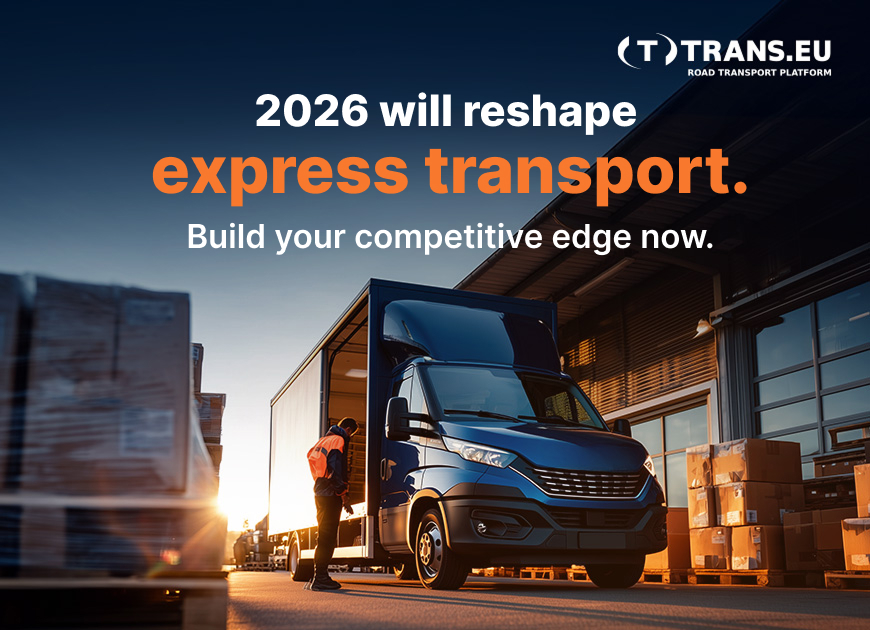
How to act strategically and secure reliable van capacity during one of the most significant market shifts of the past decade.
With 2026 around the corner, forwarders using express van transport face what may be their most challenging year since the start of the pandemic, as major regulatory and market changes take effect.
For years, forwarders have treated spot‐van transport as relatively predictable: source a vehicle, find a carrier, deliver on time, manage cost. But that era is ending.
Starting July 1st, 2026, a series of regulatory and market pressures will converge to shrink capacity, raise risk, and upend the competitive game, especially in the van + express segment. For forwarders who frequently source vans in the spot market, this isn’t a “carrier problem”. It’s your capacity problem. In this new context, the carriers who own the vans will dictate the prices, putting additional pressure on your margins.
Here’s why forwarders must act now, and how you can leverage the Trans.eu platform to transform from order-taker and load-placer into a capacity architect.
What is shifting the balance in 2026
A combination of regulation, fleet realignment and supply-chain pressures, combined with prices hikes, means the van-express supply pool is under pressure:
- From 1 July 2026, light commercial vehicles (2.5 t–3.5 t) used in international freight and cabotage must be equipped with the second-generation smart tachograph (G2V2), according to EU regulation for mobility. In an attempt to avoid this additional pressure, some carriers are already shifting their fleets to vehicles under 2.5t.
- More specifically, new EU rules will require van carriers to follow the same obligations as truck operators: recording driving and rest times with a smart tachograph, following posting-of-driver rules for work done abroad, and regularly downloading and storing tachograph data.
- Additionally, in the Netherlands, vans technically built for more than 3.5 t will pay the same €0.11/km truck toll as heavy vehicles beginning mid-2026, an unwelcome surprise for many operators. Impact on forwarders = surprise cost increases on routes through NL; prices become volatile; fewer carriers will accept DE–NL–BE express.
- Capacity in European road-freight is already showing signs of tightening, especially during peak months, as we see accelerated growth for offers on most key routes.
- Meanwhile the express-delivery market (which heavily uses vans) is forecast to grow: in Europe, it is expected to expand by USD 18.91 billion from 2025-29 (CAGR ~5.4%). This means companies will need more wheels to get their goods to their customers.
Put simply: demand for fast van transport is increasing, while the pool of compliant, flexible, low-hassle vans is about to face significantly more constraints.
For a forwarder who relies on spot sourcing, this means higher rates, fewer options, and greater risk of disruption.
What forwarders can do now to prepare
To stay ahead, forwarders can’t just wait and hope the market settles. You need to plan your sourcing strategy now, so you’re not scrambling by mid-2026. Here’s a practical checklist:
- Expand your pre-qualified pool of carriers: Identify more van carriers who are already preparing (or prepared) for the 2.5-3.5 t tachograph rules, cross-border compliance and express reliability.
- Start shifting from single-carrier sourcing to multi-carrier digital sourcing: Having a wider, verified set of carriers means you can flex when one drops out or increases price.
- Integrate compliance-visibility into your carrier evaluation: Ensure van-carriers in your network document tachograph readiness, driver-time compliance, posting rules, routing through high-cost jurisdictions.
- Educate your clients now about the price/availability risk: By positioning yourself as proactive, you build trust and avoid surprises when rates jump.
- Use digital tools and automation for speed: Spot market van transport will reward those who can source quickly, match the best carrier, dispatch fast. Manual processes will be too slow.
How Trans.eu helps you get there
That’s where Trans.eu becomes more than just another freight exchange; it becomes your strategic tool. With Trans.eu you can:
- Access a verified pool of express-van carriers: thousands of carriers vetted for documents, performance, route-experience.
- Automate spot requests and bookings: Instead of emailing or calling dozens of carriers, publish your offers on Trans.eu and get responses rapidly.
- Filter by vehicle type and readiness: Build a dedicated pool of carriers capable of meeting 2026 requirements.
- Use performance & risk data to de-risk sourcing: See carrier ratings, track history, and reviews. This matters when disruptions cost you in time or reputation.
When the market shifts, forwarders who use Trans.eu will have capacity locked in, compliant carriers lined up, and a value proposition to clients that says: “We already have a solution for you.”
The forwarders who prepare now will be the winners in 2026 and beyond
July 2026 will be a turning point for express transport. Spot-market forwarders who treat sourcing van transport the way they always have will likely find themselves squeezed, with fewer vans available, higher costs, more disruptions. But the forwarders who prepare now, who upgrade their carrier pools, who digitalise sourcing and focus on compliance, will become the capacity architects of the new era.
Don’t react to disruption. Lead through it. And with Trans.eu by your side, you’re not just buying transport, you’re building your competitive advantage for the next few years.