A freight forwarder’s guide to building a VAN carrier network in Europe
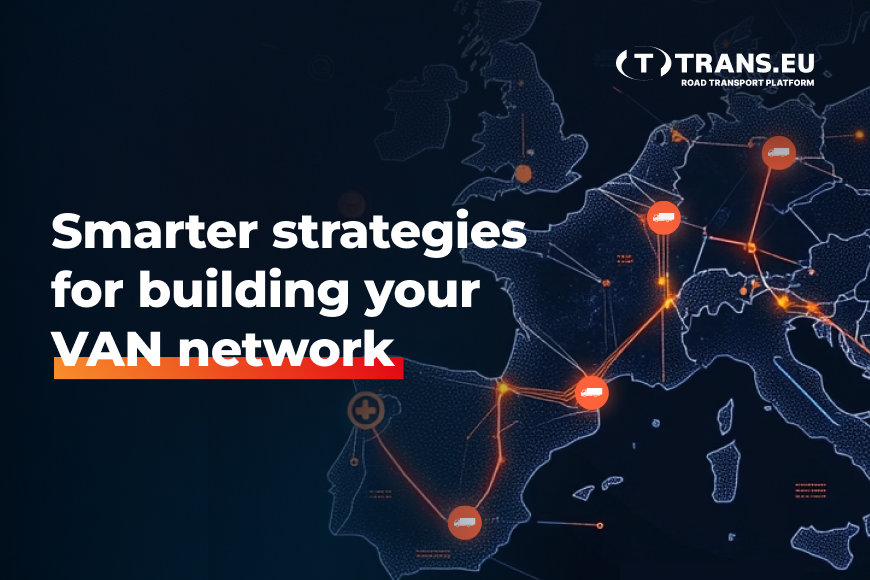
These days, global supply chains are continually disrupted by geopolitical tensions, rising cost pressures, and shifting consumer preferences, so speed and flexibility have become the must-have features of logistics.
For freight forwarders handling less-than-truckload (LTL) shipments and responding to the dynamic demands of the e-commerce market, establishing a reliable and scalable network of VAN carriers is crucial. Building such a network is no longer merely a matter of convenience but a significant competitive advantage.
Modern tools, access to actionable data, and an understanding of the European market now enable the creation of transport networks capable of rapid growth.
Geopolitics, e-commerce, and data: forces shaping the VAN market
The European VAN transport market is currently influenced by three key forces: geopolitical tensions, the rapid growth of e-commerce, and the increasing availability of operational data. Each of these factors acts as a lever transforming how freight forwarders plan and manage their carrier networks. Let’s zoom in on each of them to understand them a little better.
Geopolitics
The war in Ukraine, sanctions against Russia and Belarus, and the reorganization of trade routes have largely replaced traditional eastern corridors with Southern and Western routes. In this context, Turkey has begun to play an increasingly important role as Europe’s logistical hinterland, offering not only attractive operational costs but also a strategic location between East and West. Trade between the EU and Turkey increased by over 40% in 2023, and the number of Turkish carriers actively operating in the European Union has significantly grown.
E-commerce growth
The COVID-19 pandemic accelerated the transformation of shopping habits, with effects still visible today. Consumers expect fast, often same-day or next-day delivery of small parcels, leading to a dramatic increase in demand for transport using light commercial vehicles. For freight forwarders, this means managing a higher volume of lower-value orders with greater time sensitivity. The VAN-based operational model becomes not just an alternative but a necessity, especially in the urbanizing regions of Western Europe.
Data availability
Access to information on order fulfillment times, service quality, punctuality, and unit costs allows for faster and more accurate decision-making than ever before.
Freight forwarders using the Trans.eu Platform can select carriers based on solid metrics, peer reviews, and verification tools rather than assumptions or claims without substantiation.
Data becomes the foundation of scalability, enabling automation, optimization, and the building of resilient transport chains even in highly volatile market conditions.
Responding to new dynamics: efficiently identifying and engaging VAN carriers
Traditional methods of acquiring carriers-based on phone calls, referrals, and general advertising platforms are no longer sufficient in the face of volatility and scale. Freight forwarders now require tools that allow them to act quickly, precisely, and be data-driven.
The Trans.eu platform enables selective searching for carriers based on specific criteria such as routes, vehicle types, or ratings from other clients. This form of filtering significantly reduces the time needed to identify the right partner and simultaneously decreases operational risk. In practice, utilizing this technology can lead to cost reductions of 30-40% annually.
Data-driven selection: making more accurate decisions
In the digital age, intuition, while still important, must be supported by data analysis. Platforms like Trans.eu offer advanced tools for evaluating carriers based on actual performance parameters-punctuality, communication quality, number of completed orders, or complaint rates. Freight forwarders integrating this information with their own TMS systems can automatically assess a carrier’s suitability for a specific type of order. Automating selection and standardizing the carrier recruitment process not only improves service quality but also increases end-customer satisfaction through faster, more predictable service.
Operational optimization: automating matching and monitoring
Manually managing a carrier network takes a lot of time and often leads to mistakes or inconsistencies. To solve this, more companies are now using smart algorithms to match loads with carriers-automatically factoring in things like vehicle location, availability, cost, and past performance. This not only streamlines operations but also helps prevent delays and errors. According to data from the Trans.eu platform, fully automating the matching process can cut operational time by as much as 50%-a major advantage, especially when demand is high.
Building lasting relationships
A high-quality VAN carrier network should not be a collection of random contacts but a precisely managed ecosystem of partners. Freight forwarders who consistently invest in relationships offering carriers stable orders, transparent conditions, and efficient communication-can expect greater flexibility, better rates, and higher service quality. These relationships become even more valuable when supported by solid data: cooperation history, operational results.
As a result, companies that effectively build a base of loyal carriers report efficiency increases of up to 20% and significantly reduce supplier turnover.
Why your carrier network is your strategic asset
The VAN transport market moves fast and it doesn’t wait for slow decisions. In today’s climate, where delivery speed drives customer loyalty, the ability to build and manage your own carrier network isn’t just a competitive edge. It’s a way to stay resilient in the face of constant change. With Trans.eu, you’re not just saving time and cutting costs. You’re building a system that scales with your business. The tools you choose now will set your pace. And in logistics, pace is everything.